AI-Powered Supervisor Matching for Therapists-in-Training
- Duration
- 5 months
- Role
- UX Researcher, Design Lead, PM
- Team
- 3 Designers
- Project
- Tmind AI
Project Overview
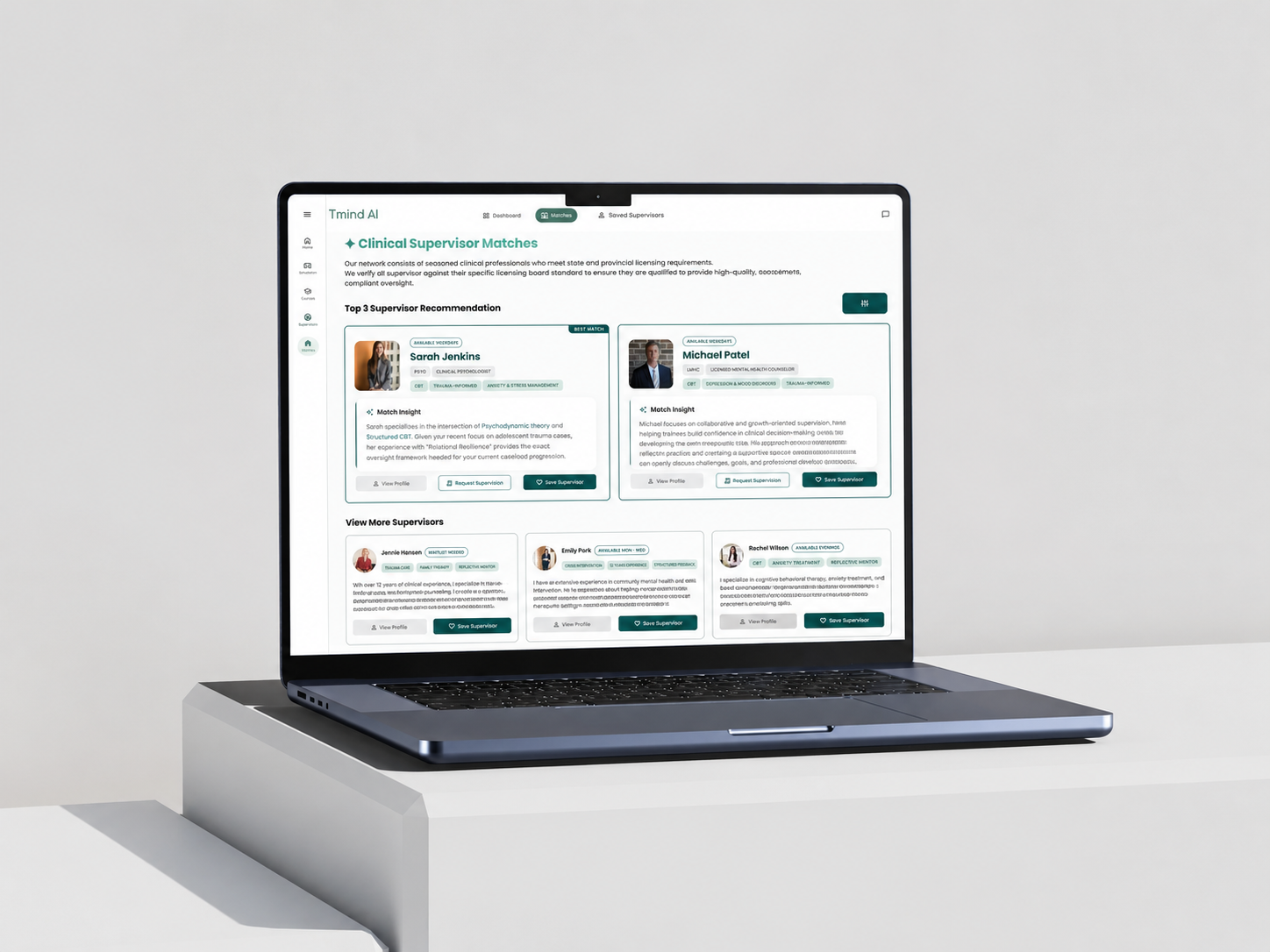
I worked as a lead UX designer and researcher on a three-person team. I contributed throughout the process, including user research, research synthesis, concept development, prototyping, usability testing, and final interface design. My primary focus was translating our research findings into the recommendation experience, particularly how we could make AI-generated matches more transparent and actionable.
Project Context
What is Tmind AI?
Tmind AI is a Seattle-based mental healthcare startup building AI-powered tools that support therapists throughout their professional journey. One of its core initiatives focuses on helping therapists-in-training find clinical supervisors through a more personalized and transparent matching experience.
The Challenge
Therapists-in-training need qualified supervisors to complete their clinical hours. However, many currently rely on personal referrals, professional networks, and fragmented online directories. This makes it difficult to determine which supervisors are available and, more importantly, which ones would be a good fit for their individual learning needs.
Users
Therapists-in-Training
Graduate students and associate therapists seeking clinical supervision.
Problem
No Centralized Directory
Finding the right supervisor relies heavily on referrals and fragmented resources.
Solution
AI Matching Platform
Personalized recommendations with transparent explanations and user control.
How might we help users confidently find the right supervisor while building trust in AI recommendations?
Research Method
Understaing user needs through interviews and and surveys.
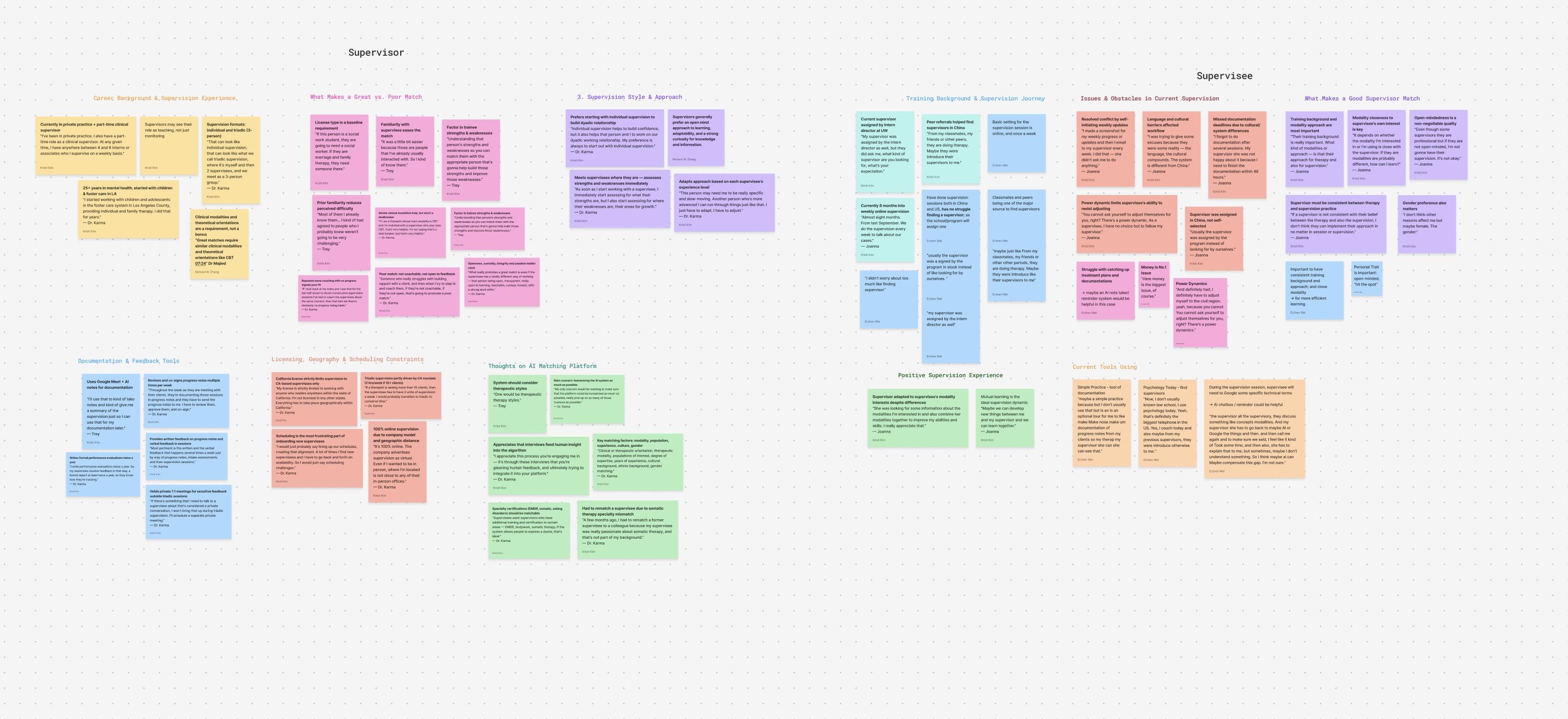
To understand how therapists-in-training and supervisors approach the supervision matching process, we combined qualitative interviews with quantitative survey data.
01
6 Interviews
30-minute sessions with 3 clinical supervisors and 3 therapists-in-training.
02
15 Surveys
Validated interview findings and identified recurring patterns.
03
Synthesis
Findings were mapped with affinity mapping and thematic analysis.
Key Findings
Three Key Insights from User Interviews and Survey Data.
Current Experience
Compatibility involved more than credentials.
Users were not only looking at a supervisor’s qualifications or years of experience. They also considered specialization, therapeutic approach, and weather the supervisor aligned with their individual learning goals.
Preference Setting
Discovering and comparing supervisors was difficult.
Even when suitable supervisors existed, users had difficulty finding and evaluating them.
AI Trust
AI should support human judgment.
Trainees and supervisors welcomed AI assistance, but wanted transparent recommendations and control over the final matching decision.
The findings showed that users were not simply looking for more supervisor options. They needed a transparent and guided process that reflected their preferences and learning goals while preserving their ability to compare and choose.
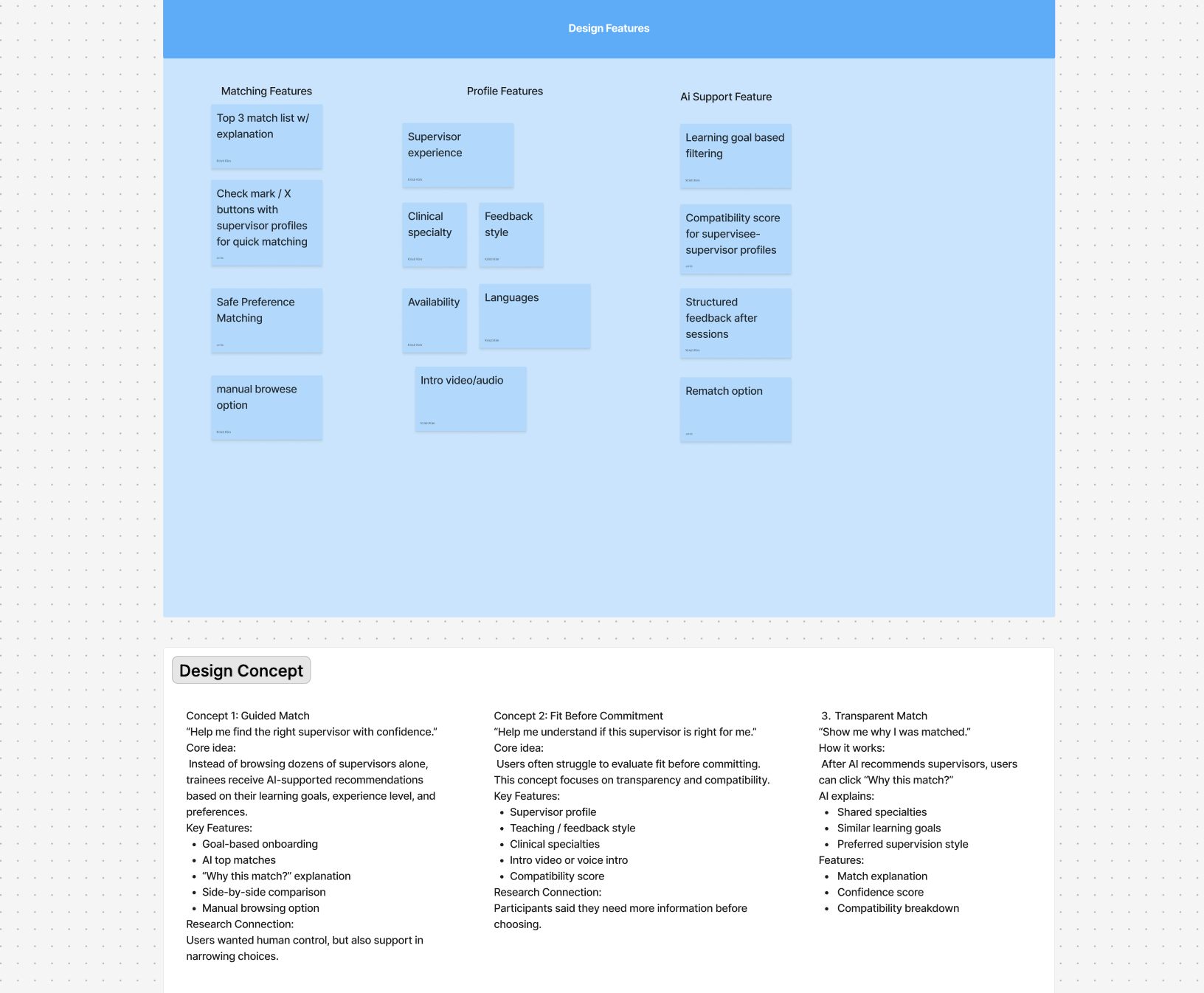
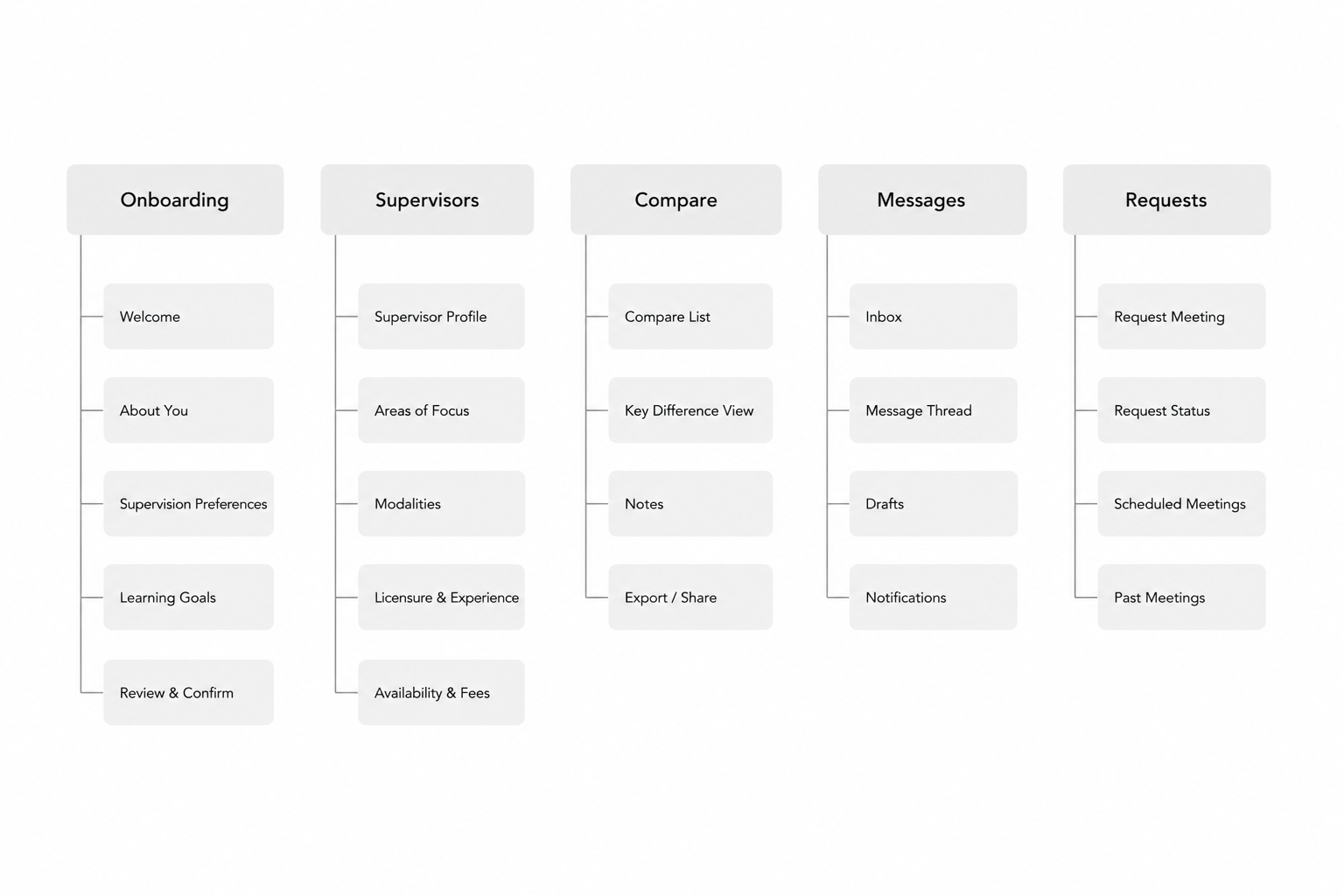
Guided by the research findings, we explored multiple concepts for how AI could support the supervision matching journey. We rapidly sketched different approaches for onboarding, preference collection, recommendation transparency, filtering, and supervisor comparison before converging on the final product experience.
Design Opportunities
Transparent Matching
Explain why each supervisor is recommended using clear rationale, relevant experience, and preference alignment.
User Control
Let trainees browse, compare, save, and make the final decision instead of relying on fully automated matching.
Meaningful Fit
Prioritize learning goals, supervision style, modality, clinical interests, and experience over surface-level convenience.
Based on the research findings, we identified three design opportunities: make AI recommendations easier to understand, preserve trainee control throughout the matching process, and prioritize the factors that define meaningful supervisor fit.
Early Concept Exploration
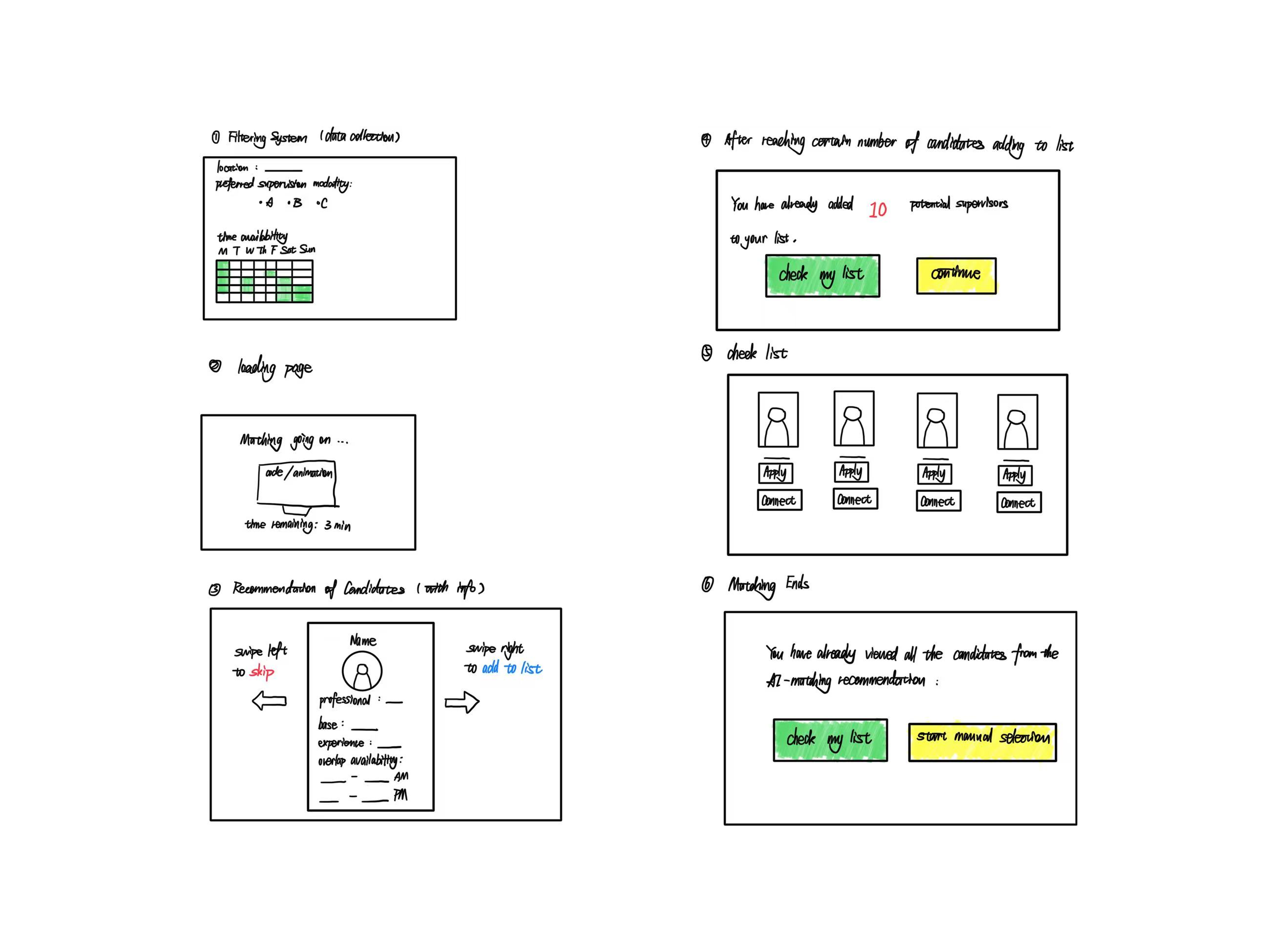
One of our initial concepts positioned AI as the primary driver of the experience. Users would enter their preferences, receive a curated set of candidates, and swipe through supervisor cards to create a shortlist.
Exploring this flow surfaced a key question:
How much should AI decide—and how much control should remain with the user?
This led us to shift toward AI-assisted discovery, giving users more control through transparent recommendations, flexible filters, and direct profile exploration.
Design System
A restrained visual system built for clarity and trust.
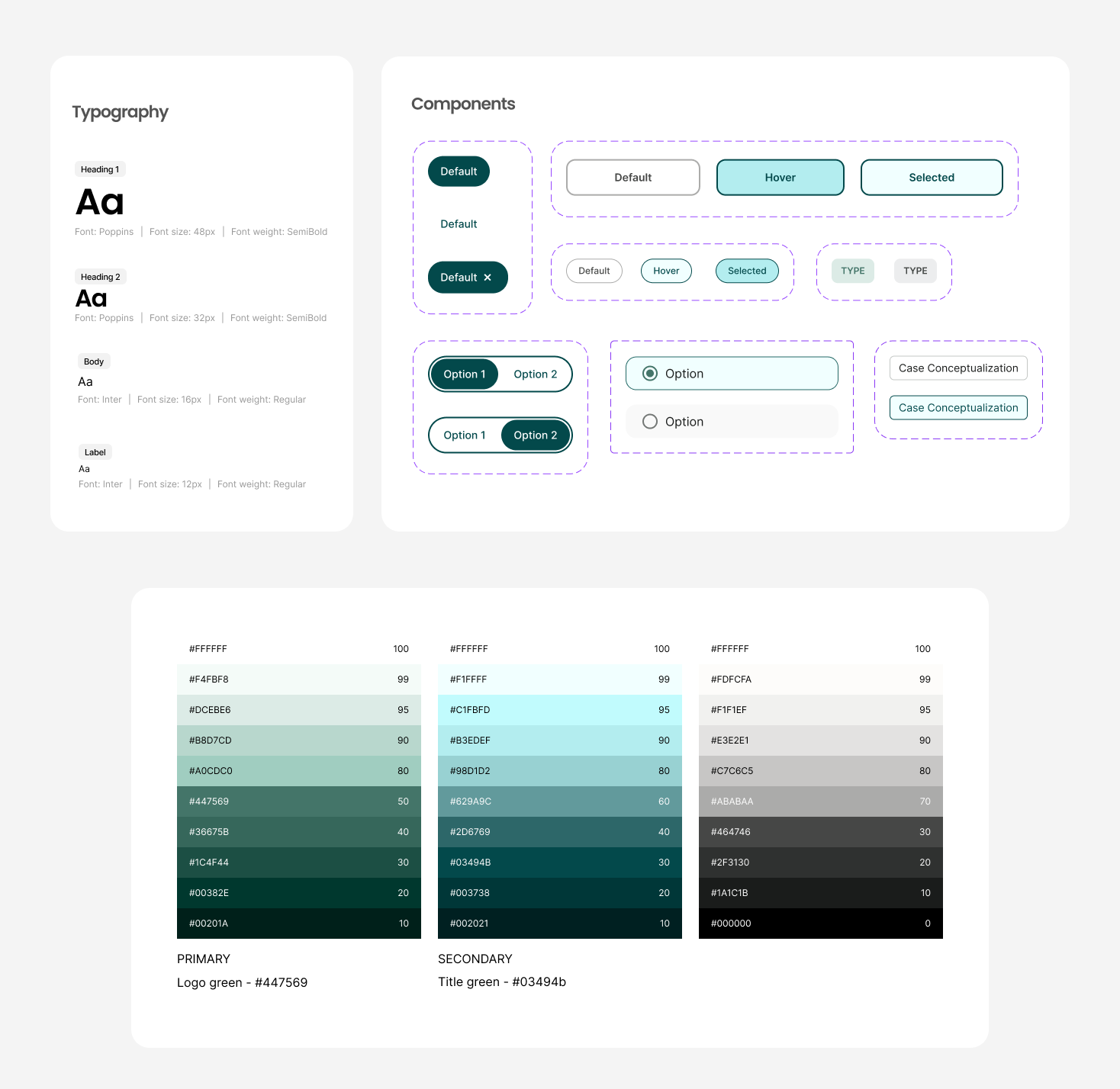
Since Tmind AI already had an established color palette and typography, we focused on preserving its brand identity while organizing the UI elements needed for the matching experience into a consistent system. We created reusable components for recurring elements such as buttons, input fields, supervisor cards, filter tags, status labels, and Match Insight.
Main Feature
Making AI Recommendations Explainable
Instead of only showing users the top recommended supervisors, we added a Match Insight that explains why each supervisor was recommended.
This way, AI helps narrow the options while users still have enough context to evaluate the recommendation and make the final decision.
Final Solution
Filtering Supervisors
Challenge
Users needed a way to narrow recommendations without feeling locked into the AI’s first answer.
Design Decision
The filter flow makes supervision type, price range, goals, specialty, modality, style, and availability adjustable in one focused layer.
Outcome
Filtering turns AI matching into a collaborative exploration tool instead of a black-box result.
Usability Testing
Users appreciated being able to refine AI recommendations, reinforcing the need for human control over AI-assisted matching.
Request Supervision
Challenge
After identifying a potential match, users needed a clear and comfortable way to initiate contact.
Design Decision
We designed a focused request flow that provides supervisor context, space for a personal message, and a clear confirmation of what happens next.
Outcome
The interaction reduces uncertainty and helps users move from evaluation to outreach.
Usability Testing
Participants found the request and confirmation flow easy to follow, suggesting that clear feedback can reduce uncertainty when moving from evaluation to outreach.
Results + Learnings
What We Validated
Usability testing indicated that participants:
- Better understood why supervisors were recommended
- Valued the ability to refine AI-generated results
- Felt more confident about the next step
- Preferred maintaining control over the final decision
Post-task questions
After viewing recommendations, participants rated standardized statements from 1 = Strongly Disagree to 5 = Strongly Agree. This made feedback comparable across sessions instead of relying only on open comments.
- 01“I understand why these supervisors were recommended.”
- 02“I felt in control of the matching process.”
- 03“I would trust this system to help me identify potential supervisors.”
What the numbers showed
0%
Task completion
17 of 20 participants finished the request flow independently.
0.0/5
Recommendation clarity
Average rating after viewing supervisor matches.
Key Learnings
- AI should support human judgment rather than replace it.
- Transparency requires explaining the recommendation—not simply showing a score.
- User control should remain available throughout the matching journey.
- Iterative testing can reveal gaps between the intended experience and users’ actual understanding.