Haven
- Duration
- 24 Hours
- Role
- UX Research, UX Design Lead
- Team
- 2 UX Designers
- Project
- Protothon 2026
Project Overview
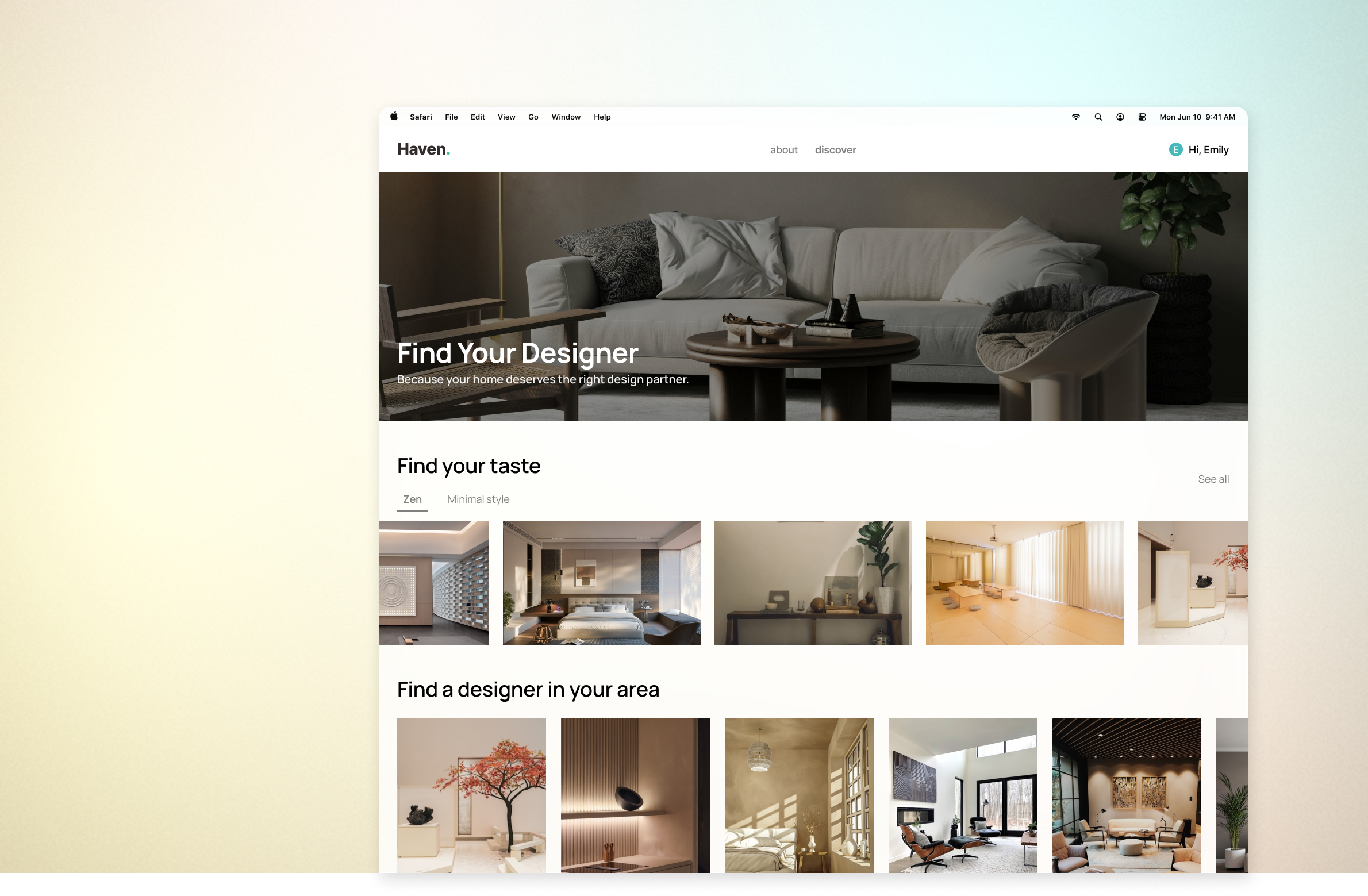
During Protothon 2026, our team designed Haven, an AI-assisted platform that helps homeowners discover designers based on style preference, budget, and project compatibility instead of relying on scattered portfolios and referrals. My contributions included UX research, product strategy, user flows, prototyping, high-fidelity UI design, and the final presentation.
Context
Users know what they like visually, but struggle to understand which designer fits their style, what the work may cost, and whether they can trust a designer with their home.
While inspiration platforms make discovering beautiful interiors easy, they fail to support the decision-making process.
How might we help homeowners confidently evaluate and connect with the right interior designer before reaching out?
Research
Existing platforms support inspiration, but not the full decision-making journey.

We compared existing platforms to identify where homeowners still needed support when moving from inspiration to renovation planning.
Design Process
Turning scattered inspiration into a structured path forward.
We focused the experience around helping homeowners understand their taste, establish budget expectations, and evaluate designer compatibility.
Research
Competitive analysisAnalyzed existing platforms to understand where homeowners lose confidence.
Define
Problem definitionFocused the problem around three confidence gaps: taste, budget, and designer fit.
User Flow
End-to-end user flowMapped the journey from visual preference discovery to budget planning, designer matching, and outreach.
Prototyping
Wireframes to interactive prototypeMoved from early wireframes into high-fidelity screens, iterating on the core matching experience within the 24-hour sprint.
Final Solution
From inspiration to confident designer selection.
Haven combines visual preference discovery, budget estimation, AI matching, and transparent designer profiles into one connected experience.
Prototype demos
Preference Discovery
Preference Discovery
Visual selection removes the pressure to understand interior design terminology.
Budget Estimation
Budget Estimation
Early cost context reduces uncertainty before users begin contacting designers.
AI Designer Matching
AI Designer Matching
AI narrows the search while keeping homeowners in control of the final decision.
Transparent Designer Profiles
Transparent Designer Profiles
Homeowners can evaluate fit beyond portfolio aesthetics.
Results + Reflection
The final direction made the search feel more guided and less uncertain.
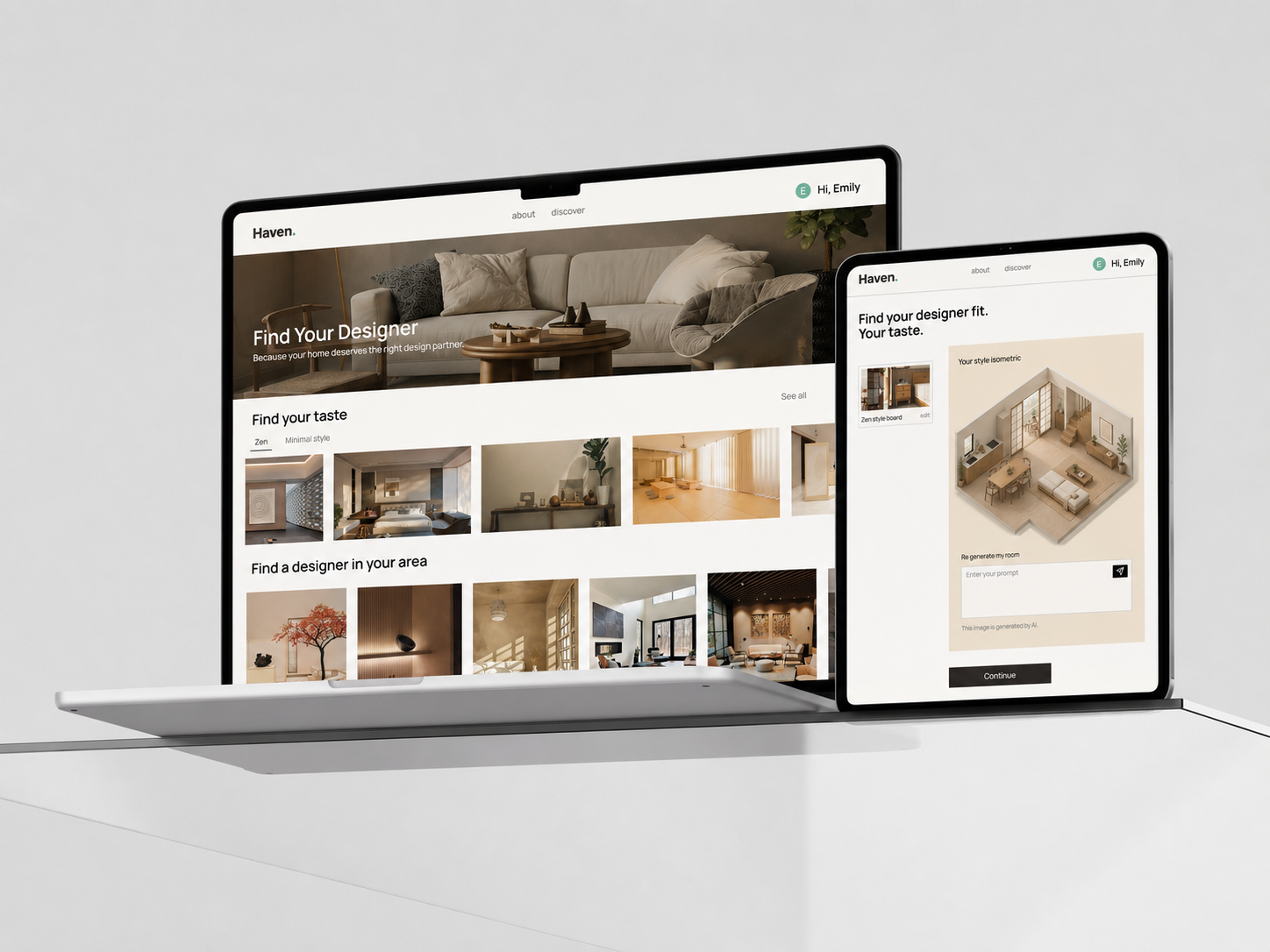
Within 24 hours, our team transformed a fragmented renovation journey into an end-to-end product concept.
Design for decision-making, not discovery.
Homeowners were not short on inspiration. The bigger opportunity was helping them confidently act on it.
AI should reduce uncertainty.
Matching became more useful when recommendations explained why a designer might fit rather than relying on an unexplained score.
Speed demands prioritization.
The 24-hour sprint pushed us to prioritize the moments that mattered most: preference discovery, budget, matching, and evaluation.